Meowdoku Tips & Hints
Five techniques that solve every board on this site, each shown on a real 6×6 board from our free levels.
A Meowdoku board never needs luck. Each tip below is one step of pure logic, and each example names its level: tap the level link to open that board in Whisker Grid and follow along. In the pictures, faint paws mark cells a cat already rules out, dark paws were placed in earlier steps, dashed outlines show the cells the tip is about, and orange shows the result.
Tip 1: Find the last free cell
Any row, column or region with exactly one free cell left must put its cat there. The fastest way to find one on a Meowdoku board is to start with the smallest regions.
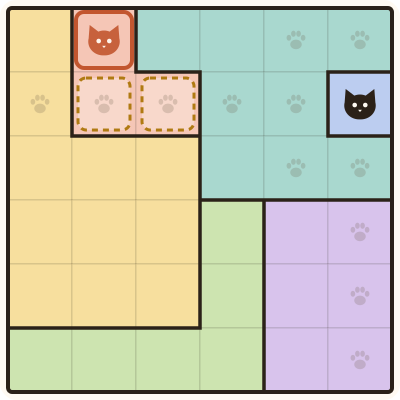
Level 21 starts with a gift: the periwinkle region is a single cell at row 2, column 6, so its cat goes straight there. That cat owns row 2, which knocks out two of the three peach cells (dashed). The peach region now has one free cell left, at row 1, column 2, so the peach cat must go there.
Tip 2: Paw around every cat
A new cat rules out its whole row, its whole column, the rest of its region and the eight cells touching it, corners included. Paw all of them before you look for the next move. Most "stuck" moments in a Meowdoku puzzle come from a cell that should have been pawed long ago. In Whisker Grid, the Auto paws switch shades these cells for you, which leaves your own paws free for the harder deductions below.
Tip 3: Spot a region stuck in one row or column
If every free cell of a region lies in one row, the cat for that row has to come from that region. Every other cell in that row can't hold a cat.
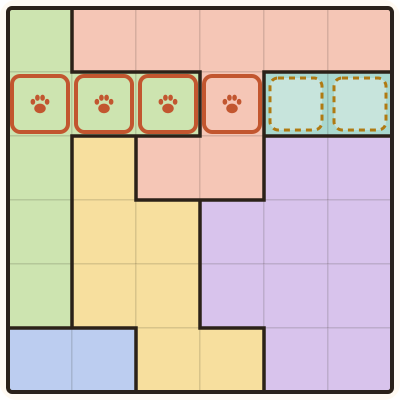
In Level 24, the mint region is just two cells, side by side in row 2 (dashed). Whichever of them gets the mint cat, that cat is also row 2's cat. So the other four cells of row 2 get paws (orange), even though nothing has been placed yet.
The same idea works with columns, and it works the other way round too: if all the free cells of a row sit inside one region, that region's cat must be in that row, so the region's cells outside the row get paws.
Tip 4: Test a cell before you commit
This is the Meowdoku tip that cracks most hard boards. Pick a cell and imagine a cat on it. If that cat would leave any row, column or region with no free cell at all, the cell is impossible and gets a paw. You never place the test cat; you only check what it would block.
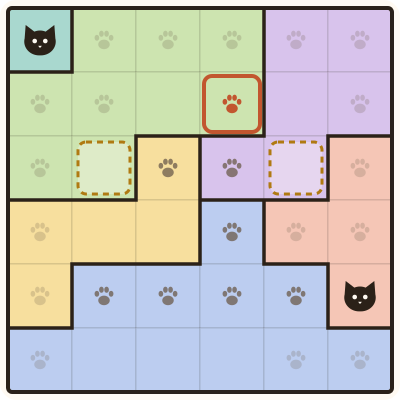
In Level 28, two cats are already down and row 3 has just two free cells: row 3, column 2 in the sage region, and row 3, column 5 in the lavender region (dashed). Now test row 2, column 4. It is also sage, so a cat there would rule out the first cell, and it touches the second one at a corner. Row 3 would be left with nowhere for its cat, so row 2, column 4 gets a paw.
Tip 5: Count regions against rows
The last of these Meowdoku tips is a counting trick. When two regions can only use cells in the same two rows, those two rows are fully booked by those two regions. Every other free cell in those rows gets a paw.
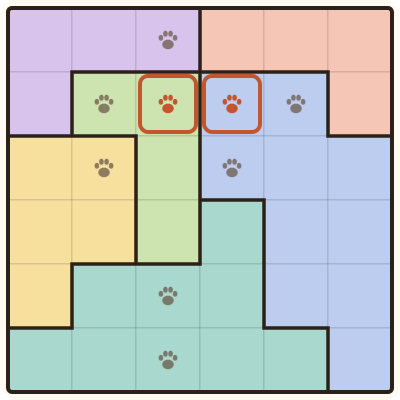
In Level 44, after a few paws, the lavender region can only use cells in rows 1 and 2, and so can the peach region. Two regions need two cats, and they can only get them from rows 1 and 2. That leaves no room in those rows for any other region, so row 2, columns 3 and 4 get paws. The same counting works with columns, with rows against regions, and with three or four regions at once. It takes longer to spot, and it comes up more often on the bigger boards.
Meowdoku hints: what to do when you're stuck
- Look again at the regions, rows and columns with the fewest free cells. Tip 1 and Tip 3 find most moves.
- Use Undo to step back, or Restart to clear the board if a guess went wrong.
- Practise on easier boards first. Our list of all 180 levels shows which boards need only the first few tips.
- Stuck on a board that isn't from Whisker Grid? Paint it into our Meowdoku solver and press Next step. It looks for these same moves and tells you which one applies.
How the Hint button works
When you press Hint in Whisker Grid, it checks your board in this order:
- If you've placed a cat that can't be part of the solution, that cat flashes. If a paw covers a cell that needs a cat, that paw flashes. Fix it and press Hint again.
- Otherwise Hint looks for the next move with the five tips on this page, simplest first. It places the cat or the paws for you and explains the reasoning in a short message next to the board (below it on a phone), so you can spot the same pattern yourself next time.
- Only if none of the five tips finds a move does Hint place one cat from the solution.
On the levels, a hint costs you nothing except the seconds on the clock. On the daily puzzle, any hint keeps that day's time off the leaderboard, so try Tips 1 to 5 first.
Meowdoku tips FAQ
Do Meowdoku puzzles ever need guessing?
Not on this site. A computer solver checked every board here: each has exactly one solution and can be solved with the five tips on this page, without guessing.
Does Hint just show the answer?
No. Hint makes one logical move at a time and explains it in a short message. Only when none of the five tips finds a move does it place a cat from the solution.
What is the best first move in Meowdoku?
Start with the smallest region, or a row or column with very few free cells. A one-cell region gives you a cat right away, and every cat you place rules out a big part of the board.
Why did my cat turn red?
A red cat breaks a rule: it shares a row, a column or a region with another cat, or it touches one, corners included. Move one of the two cats.
Do these tips work in the Meowdoku app?
The tips come from the rules alone, so they apply to any board that uses the same rules, including the boards in the Meowdoku app. The example boards on this page are from our own levels.